Learning German on Our Terms as Women and FLINTA
Learning German is not just about communication. It is essential to access jobs, education, public services, and social life.
At Hildashaus, we believe that learning German should happen on our own terms. Our approach is designed by and for the community, taking into account the needs, realities, and strengths of women and FLINTA* people. We recognize that language learning is not just about memorizing words, it is about navigating daily life, accessing opportunities, and building social connections in ways that respect people’s experiences and ways of being. This is why our programs are co-designed with participants, flexible, and culturally sensitive, so that everyone can learn in a way that fits their life, responsibilities, and community.
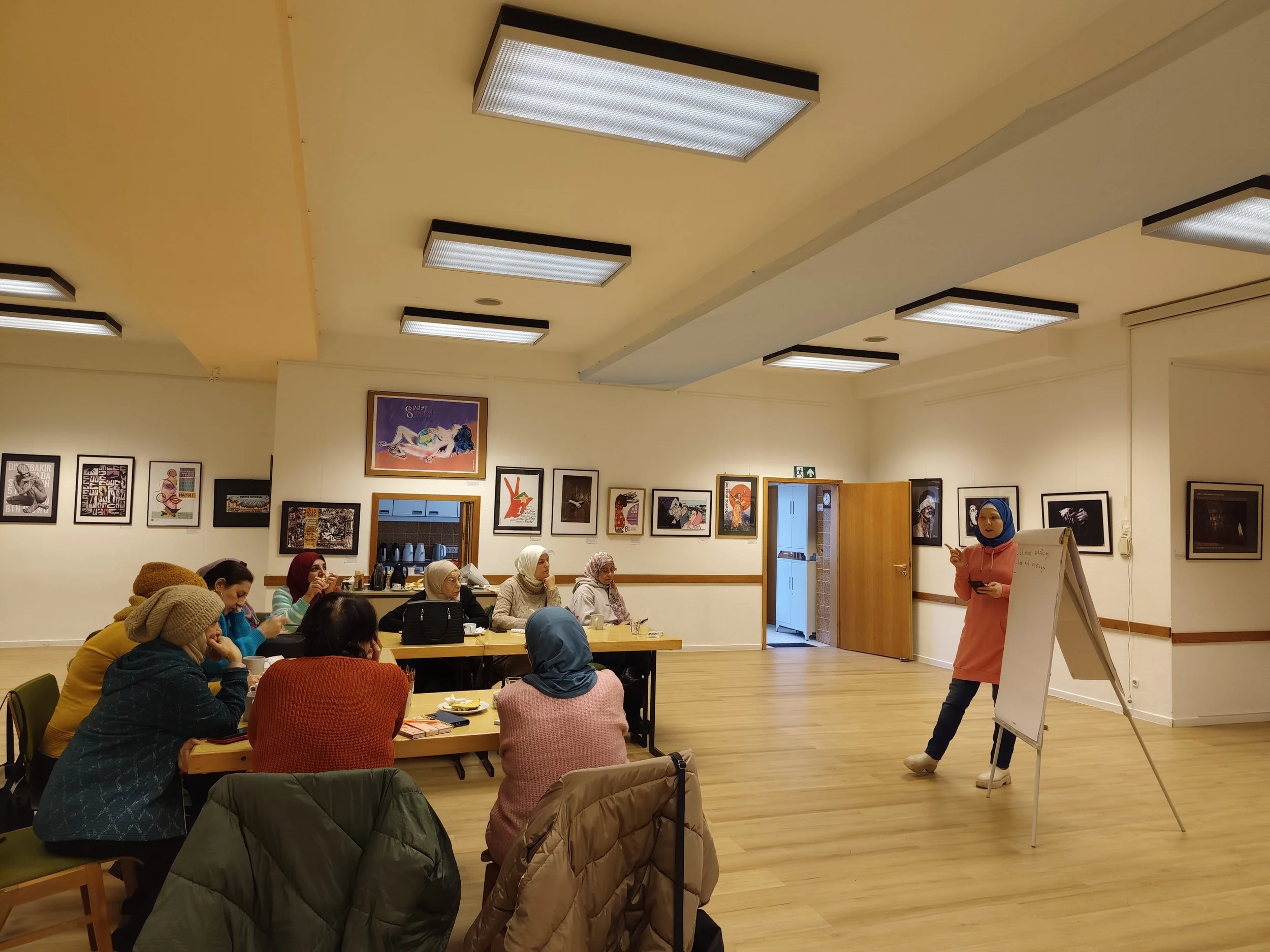
Our classes are designed to be culturally sensitive, flexible, and supportive.
What Does the Data Say?
According to a BAMF report based on the IAB‑BAMF‑SOEP survey, there are persistent gender differences in learning German. People with children or caregiving responsibilities often learn the language more slowly, the reason is because they need to spend more time on household and care responsibilities.
Data from the German Institute for Economic Research (DIW Berlin) show that only about 34% of displaced people identified as women reach an advanced level of German (B1), compared to higher numbers for men.
These reports on language learning often frame slower progress as the result of “traditional gender roles” in countries of origin. We encourage our readers to approach these studies with a decolonial lens; they can provide insight into realities on the ground, but they fail to analyze deeper systemic inequalities and the value of non-Northern ways of living. These reports approached a colonial way of thinking because it assumes that displaced women and FLINTA people must abandon their knowledge, ways of life, and cultural practices to fit into an imagined Northern ideal. While household responsibilities may be considered “problematic” for the German perspective, many cultures do not see them in the same way. For this reason, viewing women and FLINTA through this lens devalues the ways they live and exist after migrating.
The German system demands conformity to a model that exists only in the imagination of policymakers, while ignoring structural and cultural barriers in Germany itself.
Specific Challenges
While we highlight some of the challenges here, we know that there are many more challenges. These examples illustrate just a part of the structural barriers that women and FLINTA* people face when learning German, but they are far from exhaustive.
Limited access to courses
People with care responsibilities or other obligations often face long waits to access German language courses and participate less in formal programs that provide tools for social participation. The system is not designed for those who manage households and caregiving. Rigid schedules, limited spots, and the assumption that participants can attend classes full-time ignore the realities of domestic responsibilities. As a result, many struggle to access the courses they need, slowing their language learning and limiting their ability to engage fully in society.
This situation is reinforced by the gendered structure of the German labor market. Care work is often performed by women and FLINTA people, not because they are the only ones capable, but because the opportunities in Germany are organized around highly gendered norms. Jobs in sectors like heavy labor or high-paying technical fields are designed primarily for men*, while support and care work, often unpaid or undervalued, is pushed onto women and FLINTA individuals. This structural arrangement leaves them with little choice but to take on domestic responsibilities, further constraining their time, access to language courses, and participation in social programs.
Social and structural isolation
Learning a language also happens in daily life; through social interactions, schools, workplaces, and communities. However, people living in shared, temporary, or segregated housing, or with restricted mobility, have fewer opportunities to practice German outside of class. This social and structural isolation not only slows language acquisition but also limits the ability to build networks that are essential for finding work, feeling included, and participating fully in society.
Why an Intersectional and Anti‑Racist Lens Matters?
An intersectional perspective helps us understand that challenges are not “individual struggles” but outcomes of overlapping systems of discrimination, including racism, gender inequality, class divisions, and migration status.
Exclusion makes social participation more complicated, even for people who work hard to learn the language and contribute to society.
This framework matters because it shows that language barriers cannot be understood separately from broader social and political conditions; including poverty, discrimination in education and housing, unequal access to training, and labor market exclusion. Without addressing these root causes, language learning alone cannot solve the deeper problems of integration.
Political Context: Budget Cuts and Policy Shifts (2025–2026)
In 2025 and into 2026, public funding for integration services, particularly language courses and support programs, was reduced in many German states. These cuts have limited the availability of courses and extended long waiting lists, making it harder for displaced people to begin or continue language learning.
These policy changes occur in a broader climate where social participation is increasingly politicized, and where debates about migration, family reunification, and anti-immigrant sentiments have significant effects on public programs. In mid-2025, the German parliament passed a measure to halt family reunification for many people with subsidiary protection, a step seen by critics as shifting the country toward stricter migration policies that indirectly impact integration and social cohesion.
Hildashaus: Making Language Learning Accessible
At Hildashaus, we understand these challenges. That’s why we create programs where language is not a barrier. Our program, Noor Amal, is guided by cultural care, community voices, and our mission to reduce barriers in everyday life. It includes five co-designed modules, one of which is our weekly German classes.
In the Noor Amal language module, 16 participants meet every week for 30-minute sessions, each focused on one practical phrase they can use in daily life. Every session begins with a short review of the previous phrase, helping participants remember and reinforce what they have learned. The new phrase is then introduced with clear examples and explanations, showing how it can be used in real-life situations.
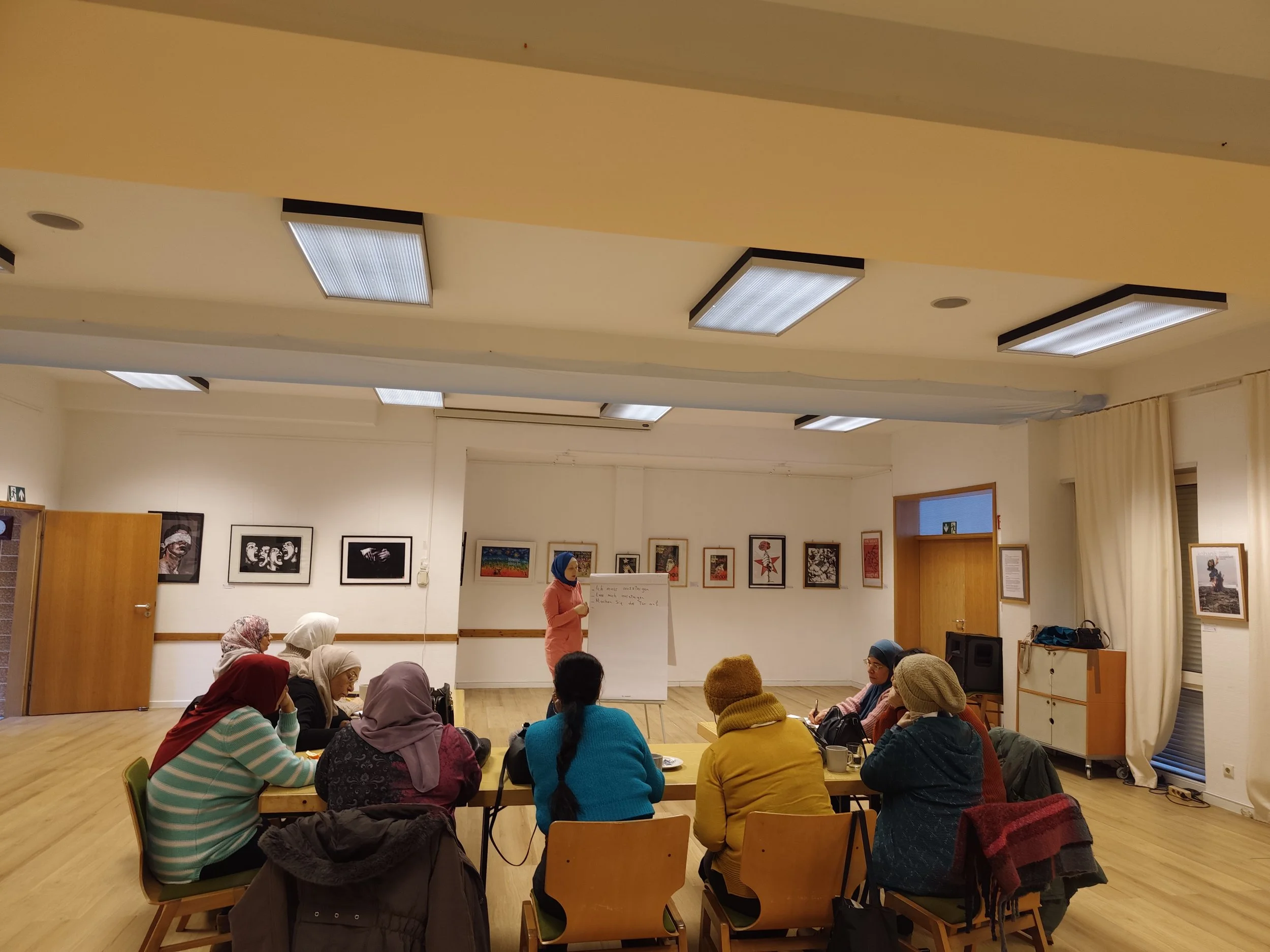
Participants in a Noor Amal language class practicing together.
The session ends with practical exercises, including dialogue, repetition, and role-play, so participants can practice speaking in a safe and supportive environment. This structured, step-by-step approach makes learning manageable, engaging, and directly connected to everyday needs, giving participants the confidence to use German in their homes, neighborhoods, and communities.
With spring coming, we also plan small outings to practice what participants have learned in real-world settings. Soon, there will also be a simple everyday German manual, so participants can continue learning at their own pace. Noor Amal shows that, with the right support and guidance, language can become a tool for independence, connection, and empowerment rather than a barrier.
